Aid to Families With Dependent Children Program Text

Help to Families with Dependent Children (AFDC) was a federal help programme in the United States in effect from 1935 to 1997, created by the Social Security Act (SSA) and administered past the United States Department of Health and Human being Services that provided financial assistance to children whose families had low or no income.
The plan grew from a small-scale part of the social security system to a meaning organisation of welfare administered by the states with federal funding. However, it was criticized for offer incentives for women to have children, and for providing disincentives for women to join the workforce. In July 1997, AFDC was replaced past the more restrictive Temporary Assistance for Needy Families (TANF) program.
History [edit]
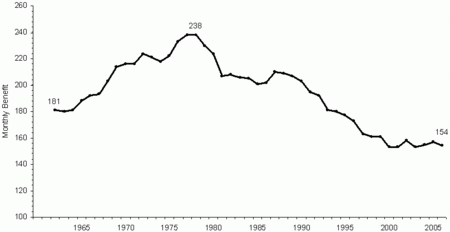
The overall pass up in welfare monthly benefits (in 2006 dollars)[1]
The program was created under the name Assistance to Dependent Children (ADC) by the Social Security Act of 1935 equally office of the New Deal. It was created every bit a ways tested entitlement which subsidized the income of families where fathers were "deceased, absent, or unable to work".[ii] : 29 It provided a directly payment of $18 per month for one child, and $12 for a 2d child.[2] : 30 [3] : 76 In 1994, the average payment was $420/calendar month.[4]
The federal government required contributions from individual states, and authorized state discretion to determine who received aid and in what amount.[2] : 30 ADC was primarily created for white single mothers, who were expected not to piece of work. Black mothers, who had e'er been in the labor strength, were non considered eligible to receive benefits.[5] In 1961 a alter in the law permitted states to extend benefits to families where the father was unemployed, a measure which 25 states eventually adopted.[6] : 164 The words "families with" were added to the name in 1962, partly due to concern that the plan's rules discouraged matrimony.[2] : 31
The Civil Rights Movement and the efforts of the National Welfare Rights Organisation in the 1960s expanded the scope of welfare entitlements to include blackness women. The welfare rolls racial demographics inverse drastically. The bulk of welfare recipients still remained white and nearly black female recipients connected to work.[5] Starting in 1962, the Department of Health and Human being Services allowed state-specific exemptions as long equally the change was "in the spirit of AFDC" in guild to allow some experimentation. By 1996 spending was $24 billion per year. When adjusted for inflation, the highest spending was in 1976, which exceeded 1996 spending by most viii%.[7] In 1967 the federal regime began requiring states to institute the paternity of children eligible for the plan, and extended benefits to "unemployed male person parents with a work history".[2] : 31
Man-in-the-business firm rule [edit]
A number of states enacted so called "man-in-the-firm" rules, which disqualified families if in that location was whatever adult male nowadays in the household whatsoever. As Williams and Hardisty phrased it:
States had wide discretion to determine eligibility and many states conditioned the receipt of welfare on the sexual morality of the female parent, using "suitable home" and "man in the business firm" rules to disqualify many African American single mothers.[8]
The "man-in-the-house" dominion was struck down in 1968 by the Supreme Courtroom in King v. Smith.[nine] Thereafter, families with males in the household were eligible for benefits if they were non deemed to exist bodily or substitute parents, although any financial contribution on the function of the male person to the family was withal considered a office of the family unit's total income.[3] : 77 Past 1981, the Supreme Court went further and required that states take into consideration the income earned by step-fathers.[3] : 77
Thirty-and-a-third rule [edit]
| Fourth dimension period | Growth |
|---|---|
| 1950-sixty | seven% |
| 1960-65 | 24% |
| 1965-70 | 125% |
| 1970-75 | 29% |
| 1975-80 | 3% |
The twelvemonth 1967 saw the establishment of the 30-and-a-third rule, which allowed families to keep their starting time $xxx earned along with one tertiary of their income following the kickoff $30 without the change affecting their eligibility for benefits.[6] : 164 [10] : 95 This and other factors led to a large increment in enrollment.[x] : 95 For example, caseloads rose 24% from 1960 to 1965, but rose 126% in the menstruation from 1965 to 1970.[6] : 166
Criticism [edit]

Early in the program, at that place were concerns about whether it encouraged unwed motherhood.[2] : 31 Some advocates complained that the rule had the upshot of breaking up marriages and promoting matriarchy:[a]
[T]he AFDC program tended to treat households with a cohabiting male who was not the natural father of the children much more leniently than those with a resident spouse or father of the children. This characteristic created a clear disincentive for marriage and also a clear incentive for divorce, because women who married face the reduction or loss of their AFDC benefits.[iii]
In 1984, libertarian author Charles Murray, author of The Bell Curve, suggested that welfare causes dependency. He argued that every bit welfare benefits increased, the number of recipients as well increased; this behavior, he said, was rational: there is little reason to work if one can receive benefits for a long period of time without having to piece of work.[6] : 162–6 His afterward work and that of Richard J. Herrnstein and others suggested possible merit to the theory of a dysgenic effect,[28] however, the data are not entirely clear.[29]
One economist was unable to observe disarming show that welfare programs have a strong effect on the dissolution of marriages.[30] But correct or wrong, this argument was amid the stepping stones leading to the modification of AFDC toward TANF.[31]
Termination [edit]
In 1996, President Nib Clinton negotiated with the Republican-controlled Congress to pass the Personal Responsibility and Work Opportunity Deed, which drastically restructured the programme. Among other changes, a lifetime limit of v years was imposed on the receipt of benefits; the newly limited nature of the replacement programme was reinforced past calling AFDC'southward successor Temporary Assistance for Needy Families (TANF). Many Americans continue to refer to TANF as "welfare" or AFDC.
TANF has remained controversial. In 2003, LaShawn Y. Warren, an ACLU Legislative Counsel, said that TANF gives states an incentive "to deny benefits to those who need it most. The solution to getting people out of the cycle of poverty is not to prematurely kick them off welfare. As well many have been denied aid unfairly, creating a false impression that the number of people who need assistance has decreased."[32] In 2006, a New Democracy editorial wrote, "A broad consensus now holds that welfare reform was certainly not a disaster—and that it may, in fact, accept worked much as its designers had hoped."[33]
Run into also [edit]
- Administration for Children and Families
- Goldberg 5. Kelly
- Universal basic income
Notes [edit]
- ^ encounter too unmarried-parent family unit
References [edit]
- ^ 2008 Indicators of Welfare Dependence Effigy TANF two.
- ^ a b c d eastward f Bare, Susan W.; Blum, Barbara B. (1997). "A Brief History of Piece of work Expectations for Welfare Mothers". The Future of Children. 7 (1): 28–38. doi:ten.2307/1602575. JSTOR 1602575. PMID 9170730. S2CID 14166595.
- ^ a b c d Grossbard, Shoshana A. (28 April 2003). Shoshana Grossbard-Shechtman (ed.). Matrimony and the Economy: Theory and Evidence from Advanced Industrial Societies. Cambridge Academy Press. ISBN9780521891431 . Retrieved 4 May 2018.
- ^ [1]
- ^ a b Roberts, Dorothy (1997). "Chapter 5". Killing the Black Body: Race, Reproduction, and the Meaning of Liberty . Pantheon Books.
- ^ a b c d due east Murray, Charles (4 August 2008). Losing Ground: American Social Policy, 1950-1980, 10th Anniversary Edition. Basic Books. ISBN9780786723775 . Retrieved iv May 2018.
- ^ U.S. Department of Health and Homo Services (website) "Federal and State Expenditures for AFDC"
- ^ "The Right's Campaign Against Welfare". Archived from the original on 2015-11-xix. Retrieved 2014-08-07 .
- ^ "Assistance To Dependent Children: The Legal History". Virginia Commonwealth University . Retrieved 4 May 2018.
- ^ a b Kiefer, Christie Due west. (2000). Wellness Work with the Poor: A Practical Guide. Rutgers University Press. ISBN9780813527772 . Retrieved 4 May 2018.
- ^ Grove, Robert D.; Hetzel, Alice G. (1968). Vital Statistics Rates in the U.s. 1940-1960 (PDF) (Report). Public Health Service Publication. Vol. 1677. U.S. Department of Health, Teaching, and Welfare, U.S. Public Health Service, National Center for Health Statistics. p. 185.
- ^ Ventura, Stephanie J.; Bachrach, Christine A. (October eighteen, 2000). Nonmarital Childbearing in the Usa, 1940-99 (PDF) (Written report). National Vital Statistics Reports. Vol. 48. Centers for Disease Control and Prevention, National Center for Health Statistics, National Vital Statistics System. pp. 28–31.
- ^ Martin, Joyce A.; Hamilton, Brady Due east.; Ventura, Stephanie J.; Menacker, Fay; Park, Melissa M. (February 12, 2002). Births: Final Data for 2000 (PDF) (Study). National Vital Statistics Reports. Vol. 50. Centers for Disease Command and Prevention, National Center for Health Statistics, National Vital Statistics System. p. 46.
- ^ Martin, Joyce A.; Hamilton, Brady Eastward.; Ventura, Stephanie J.; Menacker, Fay; Park, Melissa One thousand.; Sutton, Paul D. (December eighteen, 2002). Births: Final Data for 2001 (PDF) (Written report). National Vital Statistics Reports. Vol. 51. Centers for Disease Control and Prevention, National Center for Health Statistics, National Vital Statistics Arrangement. p. 47.
- ^ Martin, Joyce A.; Hamilton, Brady E.; Sutton, Paul D.; Ventura, Stephanie J.; Menacker, Fay; Munson, Martha L. (December 17, 2003). Births: Final Data for 2002 (PDF) (Report). National Vital Statistics Reports. Vol. 52. Centers for Disease Control and Prevention, National Center for Health Statistics, National Vital Statistics System. p. 57.
- ^ Martin, Joyce A.; Hamilton, Brady East.; Sutton, Paul D.; Ventura, Stephanie J.; Menacker, Fay; Munson, Martha L. (September 8, 2005). Births: Final Data for 2003 (PDF) (Written report). National Vital Statistics Reports. Vol. 54. Centers for Affliction Control and Prevention, National Center for Wellness Statistics, National Vital Statistics System. p. 52.
- ^ Martin, Joyce A.; Hamilton, Brady E.; Sutton, Paul D.; Ventura, Stephanie J.; Menacker, Fay; Kirmeyer, Sharon (September 29, 2006). Births: Concluding Data for 2004 (PDF) (Study). National Vital Statistics Reports. Vol. 55. Centers for Disease Control and Prevention, National Center for Wellness Statistics, National Vital Statistics System. p. 57.
- ^ Martin, Joyce A.; Hamilton, Brady E.; Sutton, Paul D.; Ventura, Stephanie J.; Menacker, Fay; Kirmeyer, Sharon; Munson, Martha L. (December 5, 2007). Births: Final Data for 2005 (PDF) (Report). National Vital Statistics Reports. Vol. 56. Centers for Disease Command and Prevention, National Center for Health Statistics, National Vital Statistics Organization. p. 57.
- ^ Martin, Joyce A.; Hamilton, Brady E.; Sutton, Paul D.; Ventura, Stephanie J.; Menacker, Fay; Kirmeyer, Sharon; Mathews, T.J. (January 7, 2009). Births: Last Data for 2006 (PDF) (Study). National Vital Statistics Reports. Vol. 57. Centers for Disease Control and Prevention, National Center for Health Statistics, National Vital Statistics System. p. 54.
- ^ Martin, Joyce A.; Hamilton, Brady E.; Sutton, Paul D.; Ventura, Stephanie J.; Mathews, T.J.; Kirmeyer, Sharon; Osterman, Michelle J.K. (August 9, 2010). Births: Final Data for 2007 (PDF) (Report). National Vital Statistics Reports. Vol. 58. Centers for Illness Control and Prevention, National Centre for Health Statistics, National Vital Statistics Organisation. p. 46.
- ^ Martin, Joyce A.; Hamilton, Brady E.; Sutton, Paul D.; Ventura, Stephanie J.; Mathews, T.J.; Osterman, Michelle J.K. (December 8, 2010). Births: Concluding Information for 2008 (PDF) (Report). National Vital Statistics Reports. Vol. 59. Centers for Disease Command and Prevention, National Center for Wellness Statistics, National Vital Statistics System. p. 46.
- ^ Martin, Joyce A.; Hamilton, Brady E.; Ventura, Stephanie J.; Osterman, Michelle J.K.; Kirmeyer, Sharon; Mathews, T.J.; Wilson, Elizabeth C. (November 3, 2011). Births: Terminal Data for 2009 (PDF) (Report). National Vital Statistics Reports. Vol. sixty. Centers for Illness Command and Prevention, National Center for Wellness Statistics, National Vital Statistics System. p. 46.
- ^ Martin, Joyce A.; Hamilton, Brady Eastward.; Ventura, Stephanie J.; Osterman, Michelle J.K.; Wilson, Elizabeth C.; Mathews, T.J. (August 28, 2012). Births: Final Data for 2010 (PDF) (Report). National Vital Statistics Reports. Vol. 61. Centers for Disease Control and Prevention, National Eye for Wellness Statistics, National Vital Statistics System. p. 45.
- ^ Martin, Joyce A.; Hamilton, Brady Due east.; Ventura, Stephanie J.; Osterman, Michelle J.K.; Mathews, T.J. (June 28, 2013). Births: Final Information for 2011 (PDF) (Study). National Vital Statistics Reports. Vol. 62. Centers for Disease Command and Prevention, National Centre for Health Statistics, National Vital Statistics System. p. 43.
- ^ Martin, Joyce A.; Hamilton, Brady E.; Osterman, Michelle J.Yard.; Curtin, Sally C. (December thirty, 2013). Births: Final Data for 2012 (PDF) (Study). National Vital Statistics Reports. Vol. 62. Centers for Illness Control and Prevention, National Eye for Health Statistics, National Vital Statistics Organization. p. 41.
- ^ Martin, Joyce A.; Hamilton, Brady E.; Osterman, Michelle J.K.; Curtin, Sally C.; Mathews, T.J. (January fifteen, 2015). Births: Final Data for 2013 (PDF) (Report). National Vital Statistics Reports. Vol. 64. Centers for Disease Control and Prevention, National Center for Health Statistics, National Vital Statistics Organization. p. twoscore.
- ^ Hamilton, Brady Eastward.; Martin, Joyce A.; Osterman, Michelle J.K.; Curtin, Emerge C.; Mathews, T.J. (December 23, 2015). Births: Final Data for 2014 (PDF) (Report). National Vital Statistics Reports. Vol. 64. Centers for Illness Command and Prevention, National Eye for Health Statistics, National Vital Statistics System. pp. 7 & 41.
- ^ Herrnstein, R. J. and Murray, C. (1994). The Bell Curve: Intelligence and Class Construction in American Life. New York: Free Press. ISBN 0-02-914673-9 pgs 191-193
- ^ The Bell Curve Flattened by Nicholas Lemann in Slate (Jan 1996)
- ^ Schoeni, Robert F. and Rebecca M. Bare. 2000. "What Has Welfare Reform Achieved? Impacts on Welfare Participation, Employment, Income, Poverty, and Family Structure." National Bureau of Economical Research Working Paper 7627. Cambridge, MA: NBER
- ^ "Transcendental goods", Reason (mag), April 1, 2004, past Nick Gillespie, "Losing Ground: American Social Policy, 1950–1980 was a devastating autopsy of welfare programs and is widely credited with helping inspire the welfare reforms of the 1990s." This is besides supported by "George Bush: The Unauthorized Biography", by Webster G. Tarpley & Anton Chaitkin Affiliate 11
- ^ ACLU Says Current Welfare Reform Measure Ineffective, Calls for Civil Rights Protections, Improve Poverty Elimination Efforts (September 10, 2003)
- ^ Fared Well. New Republic, September iv, 2006, Vol. 235, Issue x, Page vii.
Further reading [edit]
- Keith G. Kilty, Elizabeth A. Segal. The Promise of Welfare Reform: Political Rhetoric and the Reality of Poverty in the Twenty-First. (2006)
- Clarita A. Mrena and Patricia Elston. Welfare Reform: Land Sanction Policies and Number of Families Afflicted (2000)
- Robert P Stoker and Laura A Wilson. When Work Is Not Plenty: Land and Federal Policies to Support Needy Workers 2006
- Webster 1000. Tarpley and Anton Chaitkin. George Bush: The Unauthorized Biography
- Joel N. Shurkin. Cleaved Genius: The Rise and Fall of William Shockley, Creator of the Electronic Age. New York: Palgrave Macmillan. 2006. ISBN 1-4039-8815-3
- Herrnstein, R. J. and Murray, C. (1994). The Bell Bend: Intelligence and Class Structure in American Life. New York: Free Press. ISBN 0-02-914673-9
- Charles Murray, 1984. Losing Ground: American Social Policy. 1950–1980
- Nick Gillespie. "Transcendental goods". Reason (magazine), April ane, 2004
- "The Bong Curve Flattened" by Nicholas Lemann, in Slate (magazine) (January 1996)
- "Is the Dandy Society to Blame? If Not, Why Have Problems Worsened Since '60s?" by Michael Fumento, Investor's Business Daily, June 19, 1992
- "Croaky Bong" by Professor James Heckman in Reason (March 1995)
- "Federal and State Expenditures for AFDC" from the U.S. Department of Wellness and Human Services website
- "A Brief History of the AFDC Plan" from the U.South. Section of Health and Man Services (website)
- "The New Kid Care Block Grant, Country Funding Choices and Their Implications" by Sharon K. Long & Sandra J. Clark, posted to the Urban Institute website October 1, 1997
- "Women, Children, and Poverty in America" by Prudence Brown, Ford Foundation website
- "Timeline of National Welfare Reform" from PBS.org
External links [edit]
- Aid to Families with Dependent Children at HHS
- The Future of Children, Executive Summary, Center for the Future of Children, The David and Lucile Packard Foundation, at Princeton Academy website
Source: https://en.wikipedia.org/wiki/Aid_to_Families_with_Dependent_Children

Post a Comment for "Aid to Families With Dependent Children Program Text"